
Internet Protocol Television, commonly known as IPTV, has transformed how people consume entertainment. Instead of relying on traditional cable or satellite services, IPTV delivers television content over the internet, offering flexibility, on-demand access, and often lower costs. With the rise of legal IPTV platforms such as Hulu, and IPTV-supporting media players like iboplayermedia and content providers such as starprimemedia, IPTV has become a mainstream option for millions of users worldwide.
Thank you for reading this post, don't forget to subscribe!However, like any technology, IPTV is not without its downsides. Understanding these limitations is essential before choosing an IPTV service or platform. This article explores the key disadvantages of IPTV, explains how they can affect users, and highlights how legal IPTV services help minimize many of these concerns.
1. Dependence on a Stable Internet Connection
Unlike traditional cable TV, IPTV requires a consistent and high-speed internet connection to function properly.
If your internet connection is slow, unstable, or congested, you may experience:
-
Buffering and lag
-
Reduced video quality
-
Interrupted live streams
-
Complete service outages
For households with multiple devices streaming simultaneously, IPTV performance can suffer unless sufficient bandwidth is available. Legal platforms like Hulu invest heavily in adaptive streaming technology to reduce buffering, but the experience still depends largely on the user’s internet infrastructure.
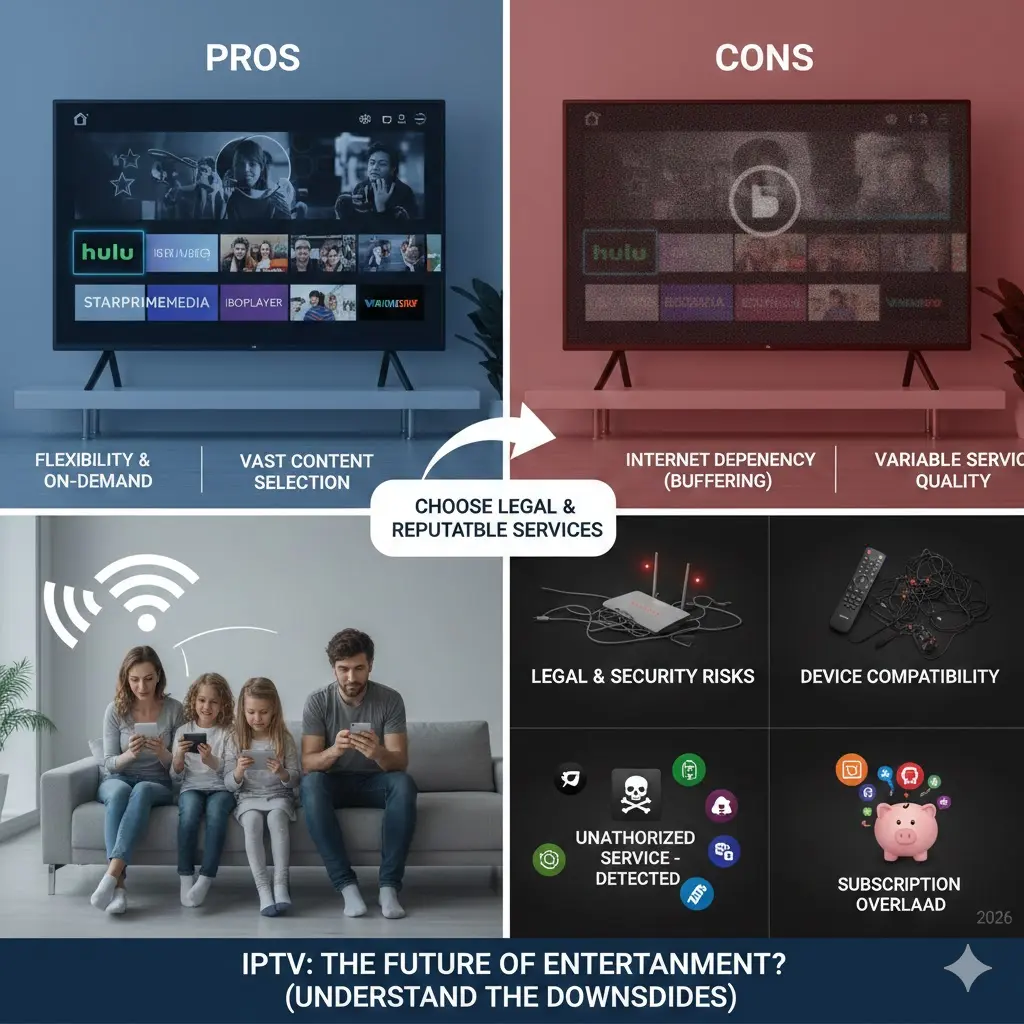
2. Variable Service Quality Across Providers
Not all IPTV services are created equal. One downside of IPTV is the wide variation in service quality, especially between legal and unauthorized providers.
Lower-quality IPTV services may offer:
-
Unreliable streams
-
Poor customer support
-
Limited content organization
-
Frequent downtime
In contrast, trusted platforms and tools such as iboplayermedia focus on stability, usability, and compatibility with legitimate IPTV sources, while content-focused services like starprimemedia emphasize curated and lawful IPTV content delivery. Choosing reputable IPTV solutions is critical to avoiding these quality-related drawbacks.
3. Legal and Compliance Risks with Unlicensed IPTV
A major concern associated with IPTV is the risk of using unlicensed or illegal services. Some IPTV providers offer access to copyrighted content without proper authorization, which can expose users to legal issues and security risks.
Potential risks include:
-
Account termination
-
Malware or data breaches
-
Poor or nonexistent consumer protections
It’s important to stress that IPTV itself is a legal technology. Services like Hulu are fully licensed IPTV platforms that comply with copyright laws. Similarly, IPTV players such as iboplayermedia are legal tools designed to work with legitimate IPTV sources. The downside arises only when users choose unauthorized providers.
4. Limited Local and Regional Content
Another downside of IPTV is that local programming availability can be limited, depending on the provider. Some IPTV services focus heavily on international or general entertainment content, which may result in fewer local news channels, regional sports, or community programming.
While platforms like Hulu have expanded local channel coverage in many regions, availability can still vary by location. Users who rely heavily on local broadcasts may find IPTV less comprehensive than traditional cable unless they select a provider that specifically supports regional content.
5. Device Compatibility and Setup Complexity
Although IPTV is often praised for its flexibility, device compatibility can sometimes be a challenge. Not all IPTV services work seamlessly across every smart TV, streaming device, or operating system.
Some users may encounter:
-
Complicated setup processes
-
App compatibility issues
-
Firmware or software update requirements
This is where IPTV-focused media players like iboplayermedia provide value. These platforms are designed to simplify IPTV playback, offering user-friendly interfaces and broad device compatibility. Still, for less tech-savvy users, IPTV can feel more complex than plugging in a traditional cable box.
6. Customer Support Limitations
Customer support quality varies significantly across IPTV services. One downside of IPTV—especially with smaller providers—is limited or inconsistent customer support.
Common issues include:
-
Slow response times
-
Limited troubleshooting resources
-
Lack of live support
Established and legal services such as Hulu tend to offer stronger customer support infrastructures, while reputable IPTV platforms like starprimemedia focus on user experience and service transparency. Choosing well-known IPTV brands reduces the risk of support-related frustrations.
7. Content Fragmentation and Subscription Overload
While IPTV offers flexibility, it can also lead to subscription fatigue. Content is often spread across multiple IPTV services, requiring users to subscribe to more than one platform to access all desired shows and channels.
This fragmentation can result in:
-
Higher cumulative costs
-
Multiple apps and logins
-
Content discovery challenges
However, IPTV also enables users to customize their viewing experience. Combining services like Hulu for mainstream content with IPTV-compatible platforms such as iboplayermedia allows users to centralize playback while maintaining legal access.
8. Security and Privacy Concerns
Security is another potential downside of IPTV, particularly when using unknown providers or apps. Poorly managed IPTV services may expose users to:
-
Data tracking without consent
-
Insecure payment systems
-
Malware-infected applications
Legal IPTV services and established platforms prioritize encryption, secure authentication, and privacy protection. Using trusted IPTV solutions like starprimemedia and recognized streaming services like Hulu significantly reduces these risks.
Final Thoughts: Balancing the Pros and Cons of IPTV
IPTV is a powerful and flexible way to consume modern entertainment, but it is not without downsides. Issues such as internet dependency, service quality variation, legal risks, and setup complexity can impact the user experience—especially when choosing unreliable providers.
That said, many of these disadvantages can be minimized or eliminated by selecting legal, reputable IPTV services and platforms. Solutions like iboplayermedia provide smooth IPTV playback experiences, starprimemedia emphasizes reliable and compliant content delivery, and Hulu stands as a leading example of a fully licensed IPTV service with robust infrastructure and customer support.
When used responsibly and legally, IPTV remains one of the most versatile and future-proof ways to enjoy digital entertainment. Understanding its downsides empowers users to make informed choices and get the most value from IPTV technology.